

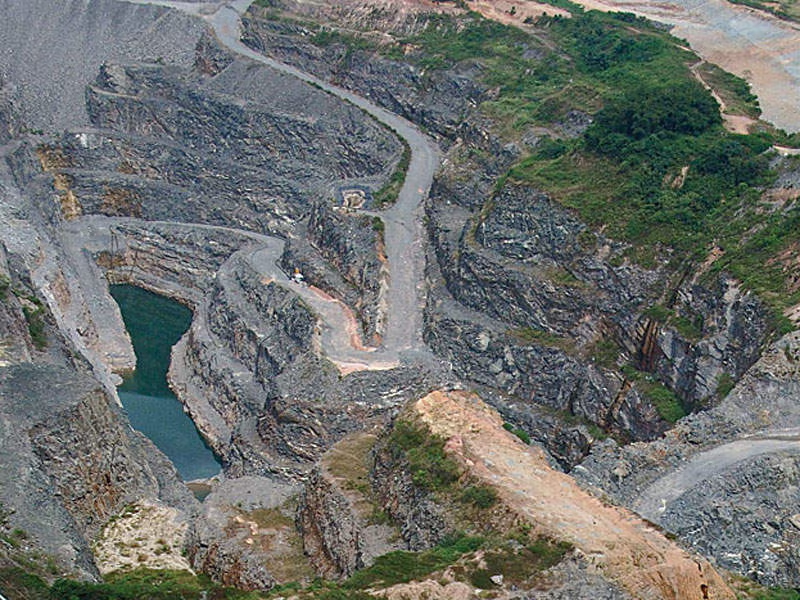
Gold Fields has announced it will officially hand over ownership and operational control of the Damang Mine to the Government of Ghana on April 18, 2026, ending its tenure at the site after more than a year of transitional arrangements. The company’s departure follows a 12-month lease extension granted after the mine’s original lease expired in April 2025. According to management, the temporary extension was meant to allow for an orderly transfer of the asset while broader discussions about its future were finalised.
Thank you for reading this post, don't forget to subscribe!Addressing journalists during a briefing on the company’s 2025 financial performance, Chief Executive Officer Mike Fraser explained that although Gold Fields sought a renewal of the lease, the government indicated its intention for the mine to revert to Ghanaian ownership — a decision the company accepted.
Since July 2025, a transition committee established by the sector ministry has been working closely with the company’s site leadership to coordinate the handover. However, Gold Fields says it has not been formally informed about who will take over long-term operations after its exit.
The transition team is expected to assume interim management responsibilities from April 19, 2026, until a substantive operator is appointed. Under Ghana’s mining laws, mineral rights revert to the state once a lease expires, leaving government responsible for determining the next ownership and operational structure. Any new operator would require the issuance of a fresh mining lease, a process that could involve parliamentary approval.
As part of the extension agreement, Gold Fields completed and submitted a detailed feasibility study on the Damang Mine to the Minerals Commission and the sector minister late last year. The study indicates that the mine has the potential to continue producing gold for at least nine more years, with estimated annual output ranging between 100,000 and 150,000 ounces.
The company estimates that prolonging the life of the mine would require capital expenditure of between US$500 million and US$600 million. Based on current gold price projections, management believes the operation would remain economically viable, though it acknowledged that a future operator may adopt a different investment or production strategy.
The issue of continuity remains critical, given the mine’s economic footprint. About 500 direct employees work at Damang, alongside between 1,000 and 1,500 contractors providing mining, logistics and energy services. Altogether, roughly 1,500 to 2,000 jobs depend on the mine’s ongoing operations.
Company leadership emphasised that both government and the transition team appear committed to avoiding disruptions that could affect workers, contractors and host communities. The lease extension, they noted, was deliberately structured to prevent sudden closure and safeguard livelihoods.
Gold Fields’ exit from Damang comes as it continues discussions with authorities over the renewal of its Tarkwa mining lease. Industry stakeholders are now watching closely to see how swiftly the government appoints a successor and secures the necessary approvals to maintain production beyond April 2026 — a process widely viewed as a key test of policy implementation and investor confidence in Ghana’s mining sector.
About The Author


More Stories
Ghana Football Association Sacks Otto Addo Weeks Before World Cup, Triggering High-Stakes Gamble
Ghana Loses $70 Million in Raw Rubber Exports Amid Under-Invoicing and Regulatory Breaches
Ghana Launches First Maternal Mental Health Policy to Tackle Postpartum Depression and Improve Family Wellbeing