

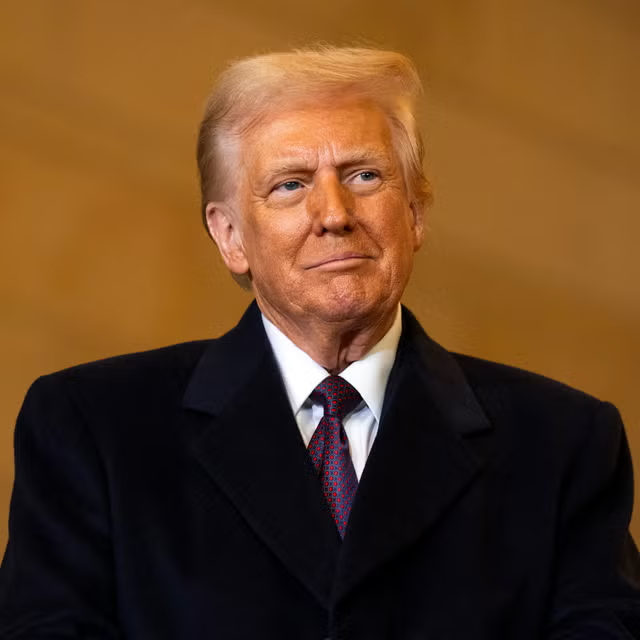
A federal judge expressed doubt on Wednesday about President Donald Trump’s effort to move the appeal of his hush money conviction into federal court, noting that his legal team had already pursued similar arguments in other venues.
Thank you for reading this post, don't forget to subscribe!US District Judge Alvin Hellerstein indicated that Trump’s attorneys may have forfeited their opportunity by initially presenting the US Supreme Court’s presidential immunity ruling to the state judge who presided over the criminal trial, rather than seeking federal court review at the outset. Trump’s lawyers did not file their federal request until nearly two months after the Supreme Court decision.
“You made a decision. You tried twice to get the same relief,” Hellerstein told Trump’s legal team during oral arguments.
The judge also pressed Trump’s attorney on the claim that the case should be transferred because Trump could assert presidential immunity as a defense. While describing the arguments as “provocative,” Hellerstein said he would take time to consider the matter before issuing a ruling.
Trump’s attorneys are seeking to relocate the appeal of his hush money conviction to federal court, where judges could more directly assess claims involving presidential immunity and federal preemption. A transfer could also speed the path for the case to reach the US Supreme Court.
Trump was found guilty in 2024 on 34 state counts of falsifying business records related to hush money payments made to adult film actress Stormy Daniels.

During Wednesday’s hearing, Hellerstein suggested Trump’s legal team made a calculated choice to first ask Judge Juan Merchan, the state judge who oversaw the trial, to consider the Supreme Court’s immunity ruling before later seeking removal to federal court—an effort that came 58 days after the high court’s decision.
Jeffrey Wall, one of Trump’s attorneys, disputed the judge’s characterization, saying it would have been inappropriate to bypass the state judge. Wall argued that the defense was under time pressure, as Trump was scheduled to be sentenced by Merchan just 10 days later.
Hellerstein responded that the law provides a 30-day window to seek removal to federal court and said Trump’s attorneys failed to meet that deadline. He added that the burden now rests on the defense to demonstrate “good cause” for the delay.
The judge suggested that the explanation offered—that the defense wanted to avoid offending the state court by going to federal court first—was insufficient.
“You made a tactical choice and are now looking for a more favorable outcome elsewhere,” Hellerstein said, adding that such conduct reflected the intent behind the filing.
At the same time, Trump is appealing his conviction in state court, a process that could eventually reach the US Supreme Court but involves additional layers of review.
Hellerstein has previously rejected Trump’s attempts to move the case to federal court, ruling that claims of presidential immunity did not apply. Trump renewed the effort after the Supreme Court clarified the scope of presidential immunity, arguing that certain evidence—such as testimony from former White House aide Hope Hicks and Trump’s social media posts while in office—was improperly introduced and warranted overturning the conviction.
In an earlier ruling denying removal, Hellerstein wrote that conduct involving private individuals and unrelated to official presidential duties does not qualify as protected executive action.
Trump appealed that decision, and in November, the US Court of Appeals for the Second Circuit sent the case back to Hellerstein for further consideration in light of the Supreme Court’s immunity ruling.
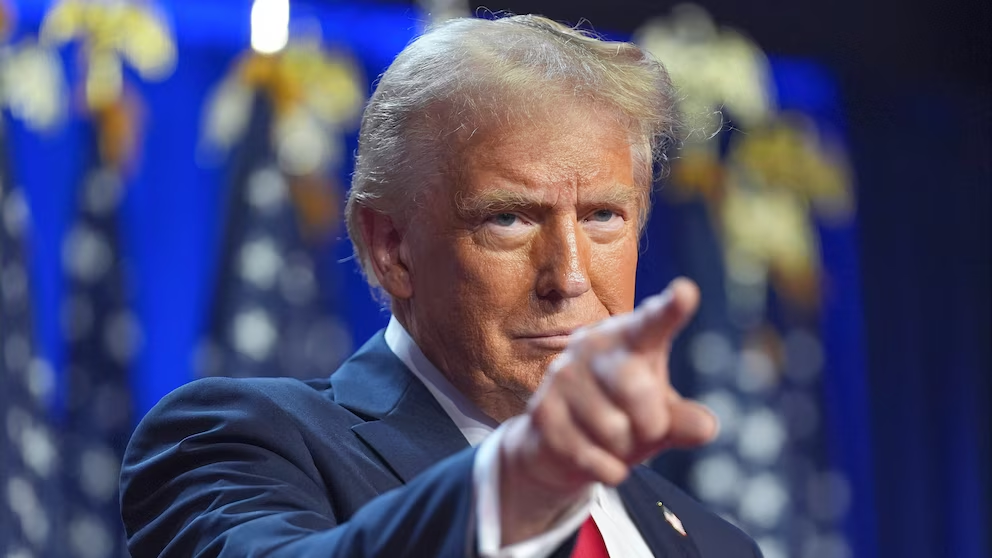
At Wednesday’s hearing, Wall argued that the Manhattan district attorney’s decision to introduce evidence he characterized as involving official acts—such as Trump’s tweets, testimony from Hope Hicks, and discussions involving the attorney general—altered the nature of the case and justified federal jurisdiction.
According to Wall, prosecutors were not required to rely on such evidence to prove their case, and once they did, the prosecution became connected to official presidential actions.
He added that the court did not need to resolve the immunity question itself, but only determine whether Trump had a “colorable defense” sufficient to justify moving the case to federal court, noting that ultimate review would fall to the Second Circuit.
Steven Wu, representing the Manhattan district attorney’s office, countered that disputes over evidence do not constitute a legal defense to criminal charges. He argued that the introduction of evidence related to official acts does not transform a case rooted in private conduct into a federal matter.
“The charges stem from actions that were entirely personal and unofficial,” Wu said.
Despite expressing skepticism toward much of Trump’s argument, Hellerstein acknowledged one procedural option he found appealing, noting that it would shift responsibility to the appellate court.
“That’s an appealing idea, because it would place the entire issue before the Court of Appeals,” the judge remarked.
About The Author


More Stories
Burkina Faso Halts Tomato Exports to Boost Local Processing Industry
World Bank Group Warns of Looming Youth Jobs Crisis as 1.2 Billion Enter Developing World Labour Markets
Pope Leo XIV Urges Immediate Ceasefire as Violence Escalates in the Middle East